
In many cases, tooth decay can be removed with a laser instead of a drill. At our practice in Küsnacht, we use an Erbium:YAG laser from Syneron for this, which precisely removes diseased tooth tissue while largely preserving healthy structure. Laser treatment for tooth decay is particularly well suited to small to medium-sized defects that are detected early. With large cavities or old fillings, however, the laser reaches its limits.
Tooth decay (caries) is a disease of the teeth caused by the metabolism of bacteria. It develops when the bacteria in plaque convert sugar from food into acid over a long period of time. Below, we explain how laser treatment works, what speaks in its favour and when other methods make more sense. For an overview of all our services, see our treatments in Küsnacht.
Causes of tooth decay
Poor oral hygiene and a diet high in sugar encourage tooth decay to develop. The actual cause, however, is caries bacteria; the bacterium Streptococcus mutans is considered particularly significant. Caries bacteria feed on sugar from food remnants that build up in plaque. When the sugar is broken down, acids are produced, above all lactic acid. These attack the tooth enamel and demineralise it.
If tooth decay is left untreated, it can reach the pulp and damage the nerve. Treating the decay alone is then often no longer enough, and root canal treatment may be needed to save the tooth. That is why it pays to detect decay early, while a small, gentle treatment is still possible.
An alternative treatment for tooth decay: laser instead of drill
Alongside the conventional method of removing decay – drilling – laser treatment has become established as an alternative. Many patients appreciate it because the typical noise and vibration of the drill are absent or considerably reduced.
Good to know: even after laser treatment, the resulting cavity is then sealed with a filling. In other words, the laser replaces the removal of the decay, not the filling itself. Whether decay can be removed entirely without drilling depends on the location and size of the defect.
How does laser treatment for tooth decay work?
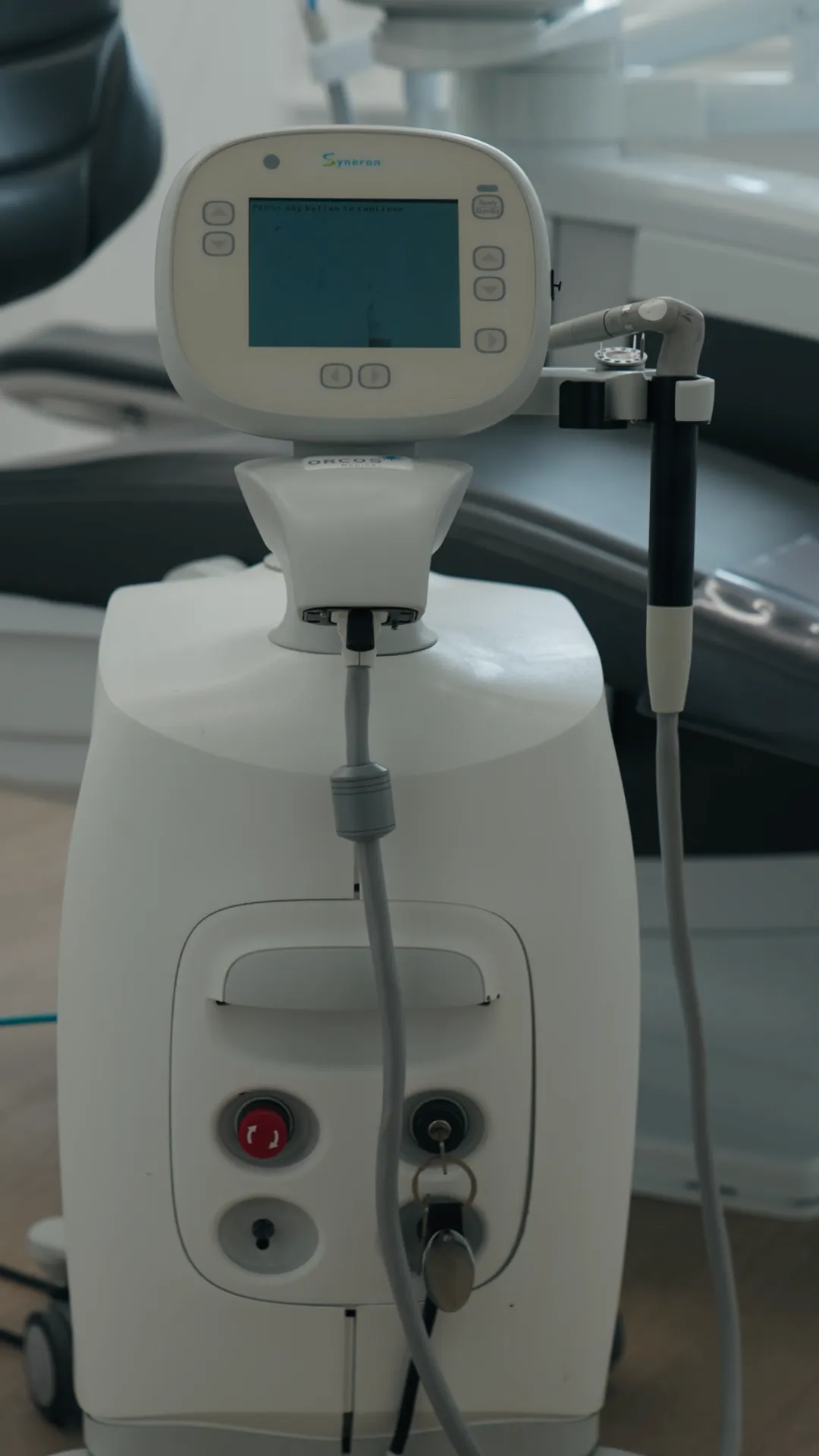
The laser emits light energy at a very specific wavelength. With the Erbium:YAG laser we use at our practice, this light is absorbed mainly by the water content in the tooth. The pulse causes tiny vaporisations, known as micro-explosions. As a result, extremely small amounts of tooth structure are literally blasted away.
Because decayed tissue contains more water than healthy enamel, it can be removed selectively. The light is aimed precisely so that, as far as possible, only the decayed areas of the tooth are treated. A fine water spray cools the tooth and protects it from heating up.
Laser treatment for tooth decay: advantages
Laser dental treatment is minimally invasive and preserves the tooth structure. The main advantages at a glance:
- Low pain: Many patients find the treatment more comfortable than drilling. Depending on the situation, little or no anaesthetic is needed; if required, we use a local anaesthetic.
- Gentle on tissue: The laser selectively removes diseased tissue. This preserves as much healthy tooth structure as possible.
- No drilling noise, hardly any vibration: Especially for people who fear the drill, this makes a noticeable difference.
- Germ-reducing: Laser light is credited with a germ-reducing effect on the treated surface.
If you are very anxious about dental treatment, please also read our article There is no need to fear the dentist. There we describe how we care for anxious patients, for example with nitrous oxide.
When the laser is not the right choice
However gentle the laser is, it does not replace the drill in every case. With large or deep carious defects, conventional treatment is often quicker and safer. Old fillings, for example made of amalgam, metal or ceramic, are also generally not removed with the laser.
We decide together with you, after the examination, which approach makes sense for your tooth. Both methods can often be combined, too.
How we work at our practice
- Examination: We examine your teeth, with digital X-rays if necessary, and determine where the decay is and how far it has spread.
- Treatment plan: We discuss with you whether the laser is suitable for your findings, what alternatives there are and what costs you can expect.
- Laser treatment: We remove the decay precisely with the Erbium:YAG laser. If needed, we use a local anaesthetic so that you can stay relaxed.
- Filling: We then seal the tooth with a tooth-coloured composite filling.
- Aftercare and prevention: We give you tips on dental care so that, ideally, new decay does not develop in the first place. Regular check-ups and professional teeth cleaning help to detect decay early.
Your well-being matters to us. We take time to answer your questions, explain every step and ensure a calm, pleasant atmosphere.
Frequently asked questions
Does laser treatment for tooth decay hurt?
Most patients find it causes little pain. Some sensation cannot be ruled out entirely; if necessary, we numb the tooth locally.
Can all tooth decay be removed with the laser?
No. The laser is best suited to small to medium-sized decay that is detected early. For large defects or under old fillings, we usually work conventionally.
Will I still need a filling afterwards?
Yes. The laser removes the decay, and the resulting cavity is then sealed with a filling.
How much does laser treatment cost?
The cost depends on the size of the defect, the number of teeth affected and the filling. The laser treatment is charged separately. On request, we will prepare a cost estimate for you in advance.
Conclusion
Dental lasers work precisely and gently. Instead of using a drill, the dentist tackles the decay with focused light, so that even the smallest areas can be treated precisely. People who fear the drill benefit in particular. The laser does not replace the drill in every case, but for decay detected early it is a very gentle alternative.
Would you like to know whether laser treatment is suitable for your teeth? Book an appointment online at our practice in Küsnacht.
Appointments & advice
Questions, or ready to book an appointment?
Write to us and we will get back to you as soon as possible. Prefer to book online or give us a call? That works too.
Karamousli Dental Practice · Seestrasse 137 · 8700 Küsnacht