
With CEREC, we make ceramic restorations such as inlays, onlays, partial crowns and crowns directly in our practice in Küsnacht. The tooth is scanned digitally, the restoration is designed on screen and milled from a ceramic block. In many cases, the restoration can be completed in a single visit. On this page, you can find out how CEREC treatment works, which materials are used and when we prefer to have a restoration made in a dental laboratory.
What is CEREC?
CEREC is a CAD/CAM system from the manufacturer Dentsply Sirona. CAD/CAM stands for «Computer Aided Design» and «Computer Aided Manufacturing», meaning computer-assisted design and production. What makes it special is that scanning, design and production all take place in the dental practice, right next to the treatment chair. Specialists therefore refer to it as «chairside» production.
The method originated in Zurich. Prof. Werner Mörmann and Marco Brandestini developed it at the University of Zurich in the 1980s. In 1985, the first ceramic restoration was made with CEREC at the treatment chair there and fitted. Since then, the system has been continuously developed and examined in numerous scientific studies.

How CEREC treatment works
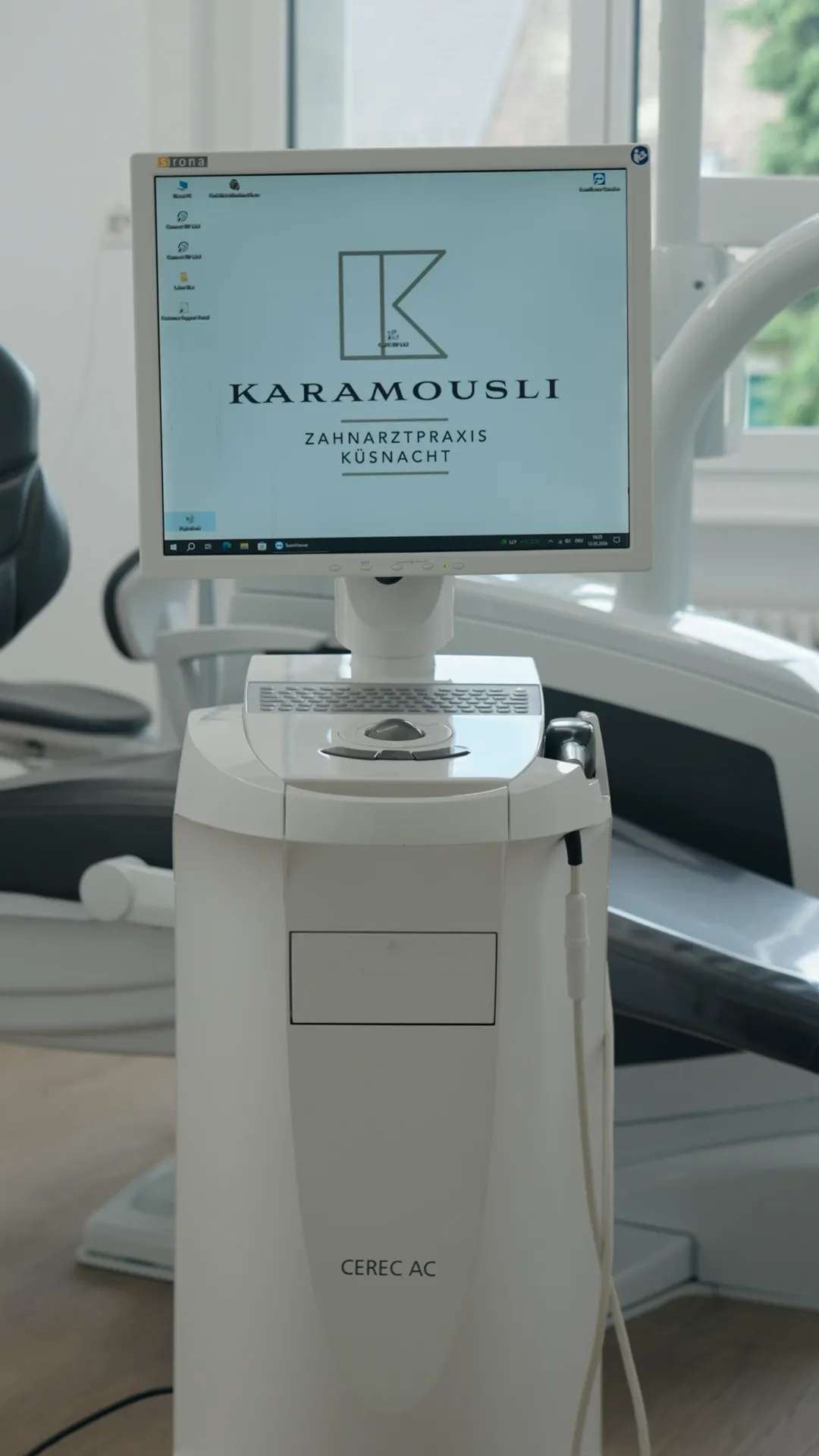
A CEREC restoration involves several steps, all of which can take place in the same appointment with chairside production:
- Examination and consultation: We examine the tooth, with digital X-rays if needed, and discuss with you whether a CEREC restoration or a laboratory-made restoration is the better fit.
- Preparing the tooth: Tooth decay or an old filling is removed and the tooth is shaped for the restoration. Specialists call this preparation. The tooth is usually numbed with a local anaesthetic for this.
- Digital scan: Instead of taking an impression with impression material, we capture the prepared tooth, the neighbouring teeth and the opposing jaw with an intraoral camera. This creates a three-dimensional model on screen.
- Design on screen: The software suggests a shape. The dentist then adjusts it, for example the chewing surfaces, the contacts with the neighbouring teeth and the bite.
- Milling: The milling unit makes the restoration from an industrially manufactured ceramic block in the matching tooth shade.
- Try-in and finishing: We check the fit and bite in your mouth. The surface is then polished or glazed and, if necessary, individually adjusted with ceramic stains. Depending on the material, it is then fired in a ceramic furnace.
- Fitting: The restoration is usually bonded adhesively, that is with a special resin cement, so that it is firmly attached to the tooth. Finally, we check the bite once more.
What can be made with CEREC
CEREC is particularly suitable for restoring individual teeth. Typical restorations are:
- Inlays: ceramic inlay fillings for larger defects that are too extensive for a composite filling.
- Onlays and partial crowns: when one or more cusps of the tooth also need to be replaced.
- Crowns: when a tooth is so badly damaged that it needs to be covered all the way round.
- Veneers: thin ceramic shells for front teeth, depending on the initial situation. You can find out more on our page about ceramic veneers.
- Bridges: in suitable cases, also on the same day. Depending on the situation, we also have bridges made in a Swiss laboratory.
Which solution makes sense for your tooth depends on the extent of the damage, the position of the tooth and your wishes. Adhesively bonded inlays, onlays and partial crowns have the advantage that more healthy tooth structure can often be preserved than with a full crown.
Material: ceramic
CEREC restorations use industrially manufactured blocks that are available in various tooth shades. Depending on the tooth and the load it bears, different materials may be suitable:
- Glass ceramic (feldspathic ceramic): translucent, similar to natural tooth enamel and easy to polish. It is used for inlays and veneers, for example, but is less strong than other ceramics.
- Lithium disilicate: a reinforced glass ceramic for front and back teeth. After milling, it is fired in a furnace, which gives it its final strength and colour.
- Zirconia: very fracture-resistant, but less translucent. It is particularly suitable for back teeth that bear heavy loads and has to be sintered in a furnace after milling.
For crowns, we use only tooth-coloured materials such as zirconia or lithium disilicate (e.max). We will discuss which material we recommend for you during planning.
Advantages of CEREC
- Often just one visit: Preparation, production and fitting can take place on the same day. You then do not need a second appointment for the fitting.
- No temporary restoration: If the restoration is fitted on the same day, you usually do not need a temporary one.
- No conventional impression: The digital scan replaces the impression tray with impression material. Many patients find this more comfortable.
- Tooth-coloured ceramic: The restoration is metal-free and similar to a natural tooth in colour and translucency.
- Checking on screen: The preparation and design can be checked on the 3D model before the restoration is milled.
When a dental laboratory makes more sense
CEREC is not the best choice for every situation. That is why our practice makes crowns both with CEREC on the same day and in the laboratory. A laboratory-made restoration often makes more sense:
- for larger bridges or extensive restorations of several teeth,
- for front teeth with high aesthetic demands, when the ceramic is to be built up by hand in several layers by a dental technician,
- for crowns on dental implants, which we have made by a partner dental laboratory,
- when a material or design is needed that cannot be produced in the practice.
We also take digital impressions for laboratory work. A bridge from the Swiss laboratory is usually ready after about a week. The dentist decides, depending on the situation, whether you receive a temporary restoration until then.
Costs
The cost of a CEREC restoration depends, among other things, on the type of restoration, the material and the extent of the preliminary treatment. On request, we can prepare a cost estimate for you in advance, either for your own information or to submit to your insurer.
Compulsory basic health insurance covers dental treatment only in exceptional cases, for example when the damage to the tooth is caused by a severe, unavoidable disease of the masticatory system or by a serious general illness. Whether supplementary dental insurance covers part of the costs depends on your policy. It is best to check this with your insurer before treatment.
Frequently asked questions about CEREC
Does a CEREC crown last as long as a crown made in a laboratory?
Ceramic restorations made with CEREC have been well researched scientifically since the 1980s. Reviews report good results in the first few years for lithium disilicate crowns, for example. When it comes to direct comparisons with laboratory work, the studies are not consistent. How long a restoration lasts in an individual case depends, among other things, on oral hygiene, teeth grinding, the size of the defect and regular check-ups.
Is the treatment painful?
The tooth is usually numbed with a local anaesthetic before preparation. The digital scan itself is not usually painful. If you are anxious about dental treatment, treatment with nitrous oxide is also available at our practice. Just ask us.
How much time should I allow?
A CEREC appointment takes longer than a standard filling, because the restoration is made and fitted in the same visit. In return, you usually do not need a second appointment. We will tell you how much time to allow for your treatment when you book your appointment.
Can an old amalgam filling be replaced with ceramic?
Often, yes. Larger old fillings, such as amalgam fillings, can be replaced with a ceramic inlay, onlay or partial crown. We assess during the examination whether replacing your filling makes sense. You can book an appointment online or by phone.
Appointments & advice
Questions, or ready to book an appointment?
Write to us and we will get back to you as soon as possible. Prefer to book online or give us a call? That works too.
Karamousli Dental Practice · Seestrasse 137 · 8700 Küsnacht