
In a full mouth reconstruction, also known as full mouth rehabilitation or complete dental restoration, all or a large proportion of the teeth in the upper and lower jaw are restored according to a single, coordinated plan. The aim is for chewing and speaking to work well again, for your teeth, chewing muscles and jaw joints to work together in harmony, and for your smile to suit your face. At our dental practice in Küsnacht near Zurich, we plan this kind of treatment step by step and discuss each stage with you.
A full mouth rehabilitation usually combines several treatments, such as dental implants, crowns and bridges, veneers or dentures. The practice owner, Dr. Tanja Karamousli, holds a Master of Science (MSc) in Aesthetic-Reconstructive Dentistry and a Master of Science (MSc) in Orthodontics, both from the Danube University Krems.
What is a full mouth reconstruction?
Unlike the treatment of a single tooth, a full mouth reconstruction looks at all your teeth as one unit. Teeth, gums, jawbone, chewing muscles and jaw joints are closely connected. When many teeth are worn, damaged or lost, the bite often changes too. In that case, it is usually not enough to repair one tooth at a time.
A reconstruction therefore rests on three pillars: a healthy foundation with inflammation-free gums and decay-free teeth, a stable bite, and aesthetics that look natural.
When does a full mouth reconstruction make sense?
A full mouth reconstruction may be an option if, for example:
- your teeth are severely worn from grinding or clenching (bruxism),
- acids from food, drinks or stomach acid have attacked your tooth enamel (erosion),
- many teeth are missing, deeply decayed or broken,
- your bite height has decreased due to wear or tooth loss,
- numerous older fillings, crowns or bridges are leaking or damaged,
- gum disease (periodontitis) has weakened your teeth,
- pain, difficulty chewing or speaking, or the appearance of your teeth is affecting your everyday life.
Not all wear needs to be treated straight away. According to current professional consensus, the causes are identified first, and milder cases are often monitored to begin with. Treatment is carried out when symptoms, function or aesthetics require it, and then in a way that is as gentle on the teeth as possible. Together, we will work out whether a full mouth reconstruction makes sense in your case or whether targeted individual treatments are enough.
Planning: function, bite and aesthetics
In a full mouth reconstruction, planning is the most important step. It usually includes:
- a detailed conversation about your symptoms, wishes, general health and habits such as grinding or diet,
- a thorough examination of your teeth, gums, chewing muscles and jaw joints,
- X-rays, including three-dimensional images (CBCT) with the Orthophos SL 3D if needed,
- a digital 3D scan of your teeth with the iTero intraoral scanner,
- photos and a record of your bite (bite registration).
With Digital Smile Design, we first plan the shape, length and position of your new teeth on screen. The planned result can then be shown directly in your mouth as a mock-up, without any teeth having to be ground down.
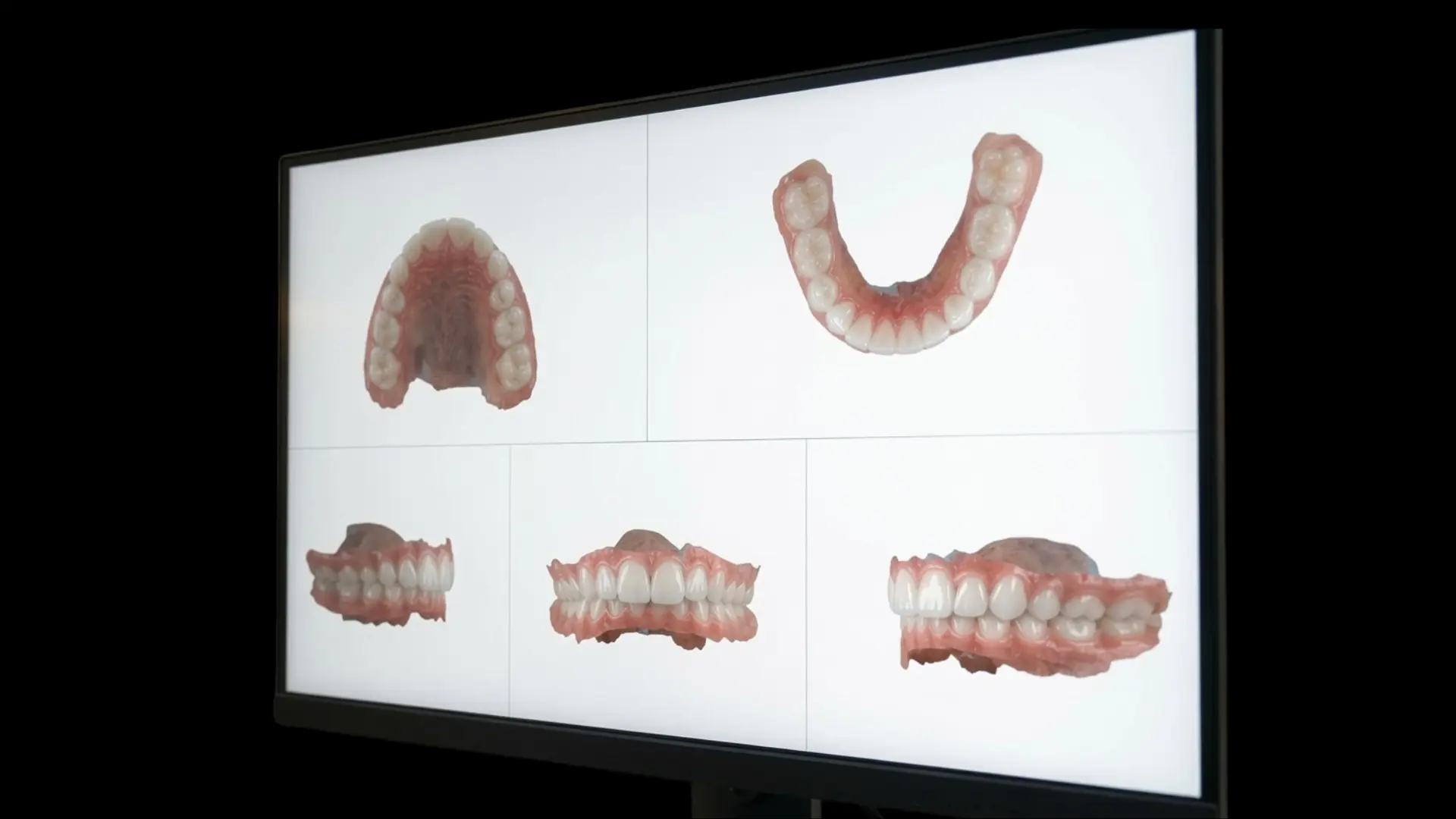
If bite height has been lost through wear, it may be necessary to raise the bite slightly. This creates space for the new restorations and helps to preserve healthy tooth structure. A new bite position is usually tested first in everyday life with temporary restorations before the final restorations are made.
How the treatment works
A full mouth reconstruction is carried out in stages over several appointments. How many depends on the scope of treatment. A typical sequence looks like this:
- Initial consultation and examination: We discuss your concerns and goals and examine your teeth, including X-rays.
- Personalised treatment plan: Based on the findings, we draw up a plan with the individual steps and discuss possible alternatives with you.
- Preliminary treatment: Inflammation and decay are treated first, for example with professional teeth cleaning, periodontitis treatment, fillings or root canal treatment. Teeth that cannot be saved are removed. New dental restorations need a healthy foundation.
- Orthodontics or surgery, if needed: Sometimes it makes sense to align the teeth orthodontically first, for example with Invisalign. We place implants using a surgical guide based on the digital 3D planning.
- Temporary phase: Temporary restorations show the shape, colour and bite position of your future teeth. You wear them in everyday life and tell us how chewing, speaking and appearance feel. We adjust them if necessary.
- Final restorations: Once the temporary restorations have proven themselves, the final crowns, bridges, veneers or dentures are made, in collaboration with a dental laboratory or, in suitable cases, with CEREC directly in our practice.
- Aftercare: At follow-up appointments, we check the healing, bite and function of your new teeth.
Treatment with nitrous oxide is available on request; you can find out more on our Afraid of the dentist page.
Which restorations are combined
The restorations we use depend on the condition of each individual tooth. Common combinations include:
- Dental implants: Implants replace missing teeth and support crowns, bridges or dentures. We mainly use implants from Straumann, as well as Thommen, and CAMLOG on request.
- Crowns and bridges: Crowns strengthen damaged teeth, while bridges close gaps. We make them from white materials such as zirconia or e.max.
- Inlays, onlays and partial crowns: These replace lost tooth structure and preserve more of your own tooth than a full crown. With CEREC, they can be made in a single session in suitable cases.
- Veneers: Ceramic veneers change the shape, colour and length of front teeth.
- Partial and full dentures: Custom-made dentures restore function and aesthetics when many or all teeth are missing. They can also be anchored on implants.
- Periodontal treatment: Treating gum disease creates a healthy foundation for all further steps.

If your main concern is the appearance of individual teeth, you will find further options under aesthetic dentistry.
After treatment
An extensive reconstruction needs regular care. This includes thorough oral hygiene at home, professional teeth cleaning and regular check-ups, at which we also check your bite and restorations.
If you grind or clench your teeth at night, this also puts strain on new crowns and veneers. In this case, a custom-made night guard (occlusal splint) is often recommended to protect your teeth and restorations. Even with good care, ceramic or composite can chip over time. Minor damage can often be repaired.
Cost of a full mouth reconstruction
The costs cannot be given as a flat rate. They depend on how many teeth are treated, which preliminary treatments are needed, whether implants are placed and which materials are suitable. On request, we will prepare a cost estimate for you after the examination, which you can also submit to your insurer. You can find our current tariff point values on our website.
Frequently asked questions
How long does a full mouth reconstruction take?
That depends on the scope: on the preliminary treatment, the healing time of any implants and the length of the temporary phase. We will discuss a realistic timeline with you together with the treatment plan.
Does everything have to be treated at once?
No. A full mouth reconstruction is planned in stages. Urgent problems such as pain or inflammation take priority, and the further steps then follow in a sensible order.
Will I be without teeth during treatment?
The aim is for you to be well looked after during the interim phases too. The dentist decides which type of temporary restoration makes sense in your situation, depending on your starting point, and discusses it with you beforehand.
Is the treatment painful?
The procedures are carried out under local anaesthetic. You may experience temporary discomfort after surgical steps. For anxious patients, treatment with nitrous oxide is possible. On request, we can clarify whether treatment under general anaesthetic with an anaesthesia team is an option in your case.
Your path to a new smile
If you have several dental problems at the same time or would like your teeth comprehensively restored, we will be happy to advise you at our practice on Seestrasse in Küsnacht. In the first consultation, we will clarify your needs and show you the options available in your situation.
Contact us to book an appointment.
Appointments & advice
Questions, or ready to book an appointment?
Write to us and we will get back to you as soon as possible. Prefer to book online or give us a call? That works too.
Karamousli Dental Practice · Seestrasse 137 · 8700 Küsnacht